
ALCOHOL
A… love that costs a lot
Alcohol is closely linked to many aspects of our lives. However, behind it there is always the risk of alcoholism, if one takes into account the fine line that separates its acceptable from unacceptable consumption. But what are the risks to our health and especially to the liver?
Written by
Dimitrios Kountouras
Hepatologist, Director of the 2nd Pathological – Hepatological Clinic of MITERA
It is linked to life, to joy and sorrow, to everyday life and celebration, to religion and art, to love and death. It is alcohol. A gift of nature, the only thing it lacks is moderation: the frequency of alcoholics worldwide is 6% (WHO). This abuse is “punished” by nature by deducting 10-12 years of life, without counting the years that are actually sacrificed in quality of life.
It is important to have no illusions and to agree on what abuse is. Each drink, that is, one serving, contains 17-20 g. of pure alcohol. When we refer to moderate consumption, for men we mean less than 2 drinks per day and for women less than one! So no more “jokes”: a can of beer (330 g.), two glasses of wine (170 g.), a 50-gram ouzo, a glass of whiskey (50 g.) is what constitutes the maximum safe dose per day. Consumption of more than 4 drinks per day for men and 3 for women is considered dangerous.
Episodic abuse, that of the weekend or the total weekly consumption of more than 14 drinks for men and only 7 for women, constitutes a potential risk. More than 5 drinks per day for men and more than 4 for women, for six months, with a high probability, constitutes alcoholism!
The general effects
Alcohol provides large amounts of calories to the body. The alcoholic covers 1/2 of his energy needs with alcohol, as alcohol (ethanol) is an energy source of 7.1 kcal (29.7 J)/g, taking the place of normal nutrients. The result is malnutrition and the lack of many vitamins. The misleading thing about “Greek-style” alcoholism is that alcohol is accompanied by a lot of fatty food, the abuse is concealed due to the avoidance of the effects of acute intoxication and alcoholism is aggravated by the disease of obesity.
Acute intoxication, in addition to loss of motor control, can develop with disorders of all systems, such as suppression of the central nervous system, the myocardium or the respiratory system, with aspiration, tachycardia, dehydration due to increased diuresis, hypoglycemia, acute pancreatitis, atrial fibrillation, pulmonary edema, cardiogenic shock and sudden death, which truly constitute a nightmare in the paradise of alcoholic pseudo-euphoria.
Devastating effects
While alcoholism seems to be a purely “male” affair with a ratio of 10 to 1, alcoholic liver disease affects 3 men to 1 woman, 10 years earlier than men, as the female body has less water and more fat than the male and lower levels of alcohol dehydrogenase, which metabolizes ethanol.
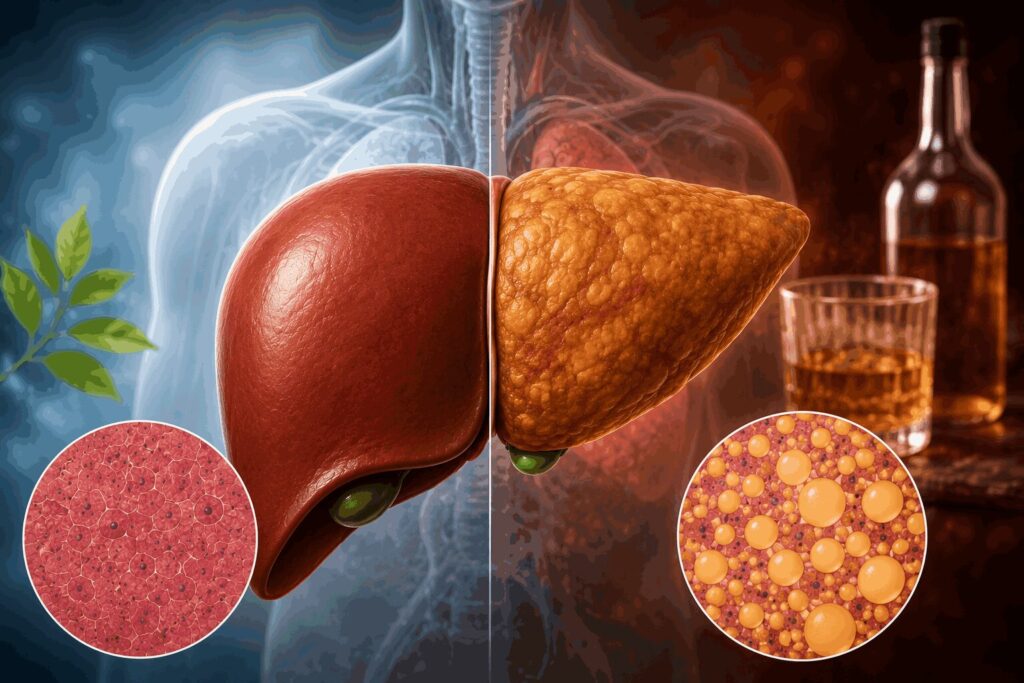
Alcohol damages the liver through oxidative mechanisms, with a decrease in cellular antioxidant factors. Liver damage manifests as severe acute alcoholic hepatitis, more chronically as simple fatty infiltration and, finally, as chronic alcoholic hepatitis, ending in cirrhosis.
Acute alcoholic hepatitis presents as anorexia, fever, malaise, abdominal pain and -in more severe form- with jaundice and hepatic encephalopathy, which progresses to fulminant liver failure, with dramatic clinical picture and laboratory control.
Cirrhosis is asymptomatic in 10%-20% of patients. In the long term, it manifests with ascites and variceal bleeding, as it is characterized by very severe portal hypertension, but also with a classic picture of liver failure. Characteristic findings of alcoholism are Dupuytren’s contracture in the palms and swelling of the parotid glands. Transaminases are usually elevated, but almost never at values above 400 units, the AST:ALT ratio ≥2 in 80%, while the increase in γ-GT is characteristic, even without any other clinical and laboratory disorder (enzyme induction). Alcoholic liver disease, when there is only steatosis, is generally considered benign and may begin to regress within 2-4 weeks of stopping alcohol. Early or late, stopping alcohol is extremely beneficial, in a short period of time.
No one gives up alcohol easily and whenever they want, as it is persistent, insidious and vindictive, causing the addict (who usually does not know and does not admit that he is addicted) separation anxiety and, in some cases, the terrible withdrawal syndrome within 2-5 days of stopping.
The love of alcohol, if left to one’s own devices, constitutes a destructive and deadly relationship, as it demands that one stay with it throughout one’s life, a worse and shorter life, one that one and one’s people ultimately lack.